Typical Problems and Identification Methods for Under-Fermented or Over-Fermented Tobacco and Their Impact on Final Flavor
In April 2023, at a cigar tobacco pilot line in Hubei, leaves from the same batch of mid-stalk Viso, from the same curing barn, were split into two paths: one followed the process card through two rounds of stacking, with core temperature peaks held at 44–46°C and four stack turnovers; the other, pressured by urgent orders, only received two turnovers in the second round and had roughly 9 fewer total fermentation days before entering the blending room.
Only three people were at the tasting table that day. The under-fermented roll hit the nasal cavity with a sourness in the first 2 centimeters — not the "structural bite" of pepper, but a harshness like unclosed cleaning fluid mixed with raw green grass; the mid-palate wood aroma barely emerged, both sides of the tongue felt astringent, and the finish was like biting into an unripe green tomato. The fully fermented roll was equally strong, but the strength sat further back: light fermentation acid and damp wood up front, clear pepper in the middle, and a touch of dry sweetness from cocoa shells at the finish.
The blender only said one thing on the spot: "That under-fermented batch looks strong, but it actually hasn't finished the path it was supposed to walk." This article is about exactly that — how to identify under-fermentation and over-fermentation from taste (supplemented by aroma, leaf surface, and ash), and why these two types of damage are nothing like the same disease.
Let me nail down my position first: whether fermentation is sufficient is ultimately judged by the senses, not the calendar. Calendar days, core temperature, and moisture content are only process instruments; taste is the final reading. Both under- and over-fermentation ruin flavor, but under-fermentation is more often mistaken by novices as "strong and good material," while over-fermentation is more often mistaken as "mellow and premium" — these two misreadings cost more than the process itself.
I. First, Align the Spectrum: What Under, Proper, and Over Fermentation Each Taste Like
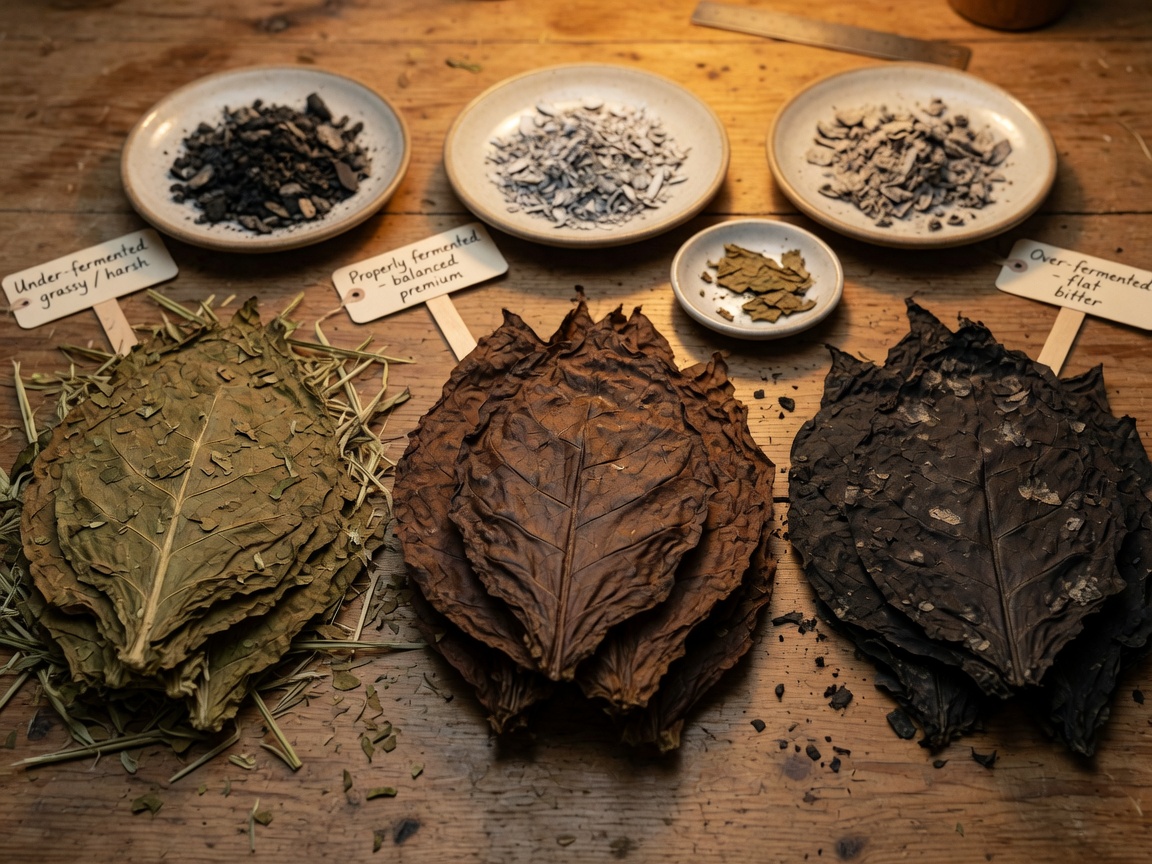
What fermentation does after curing is pragmatic: suppress green/off-notes and raw harshness, drive the transformation of proteins, sugars, pigments, and aroma precursors, let the ammonia sensation that rushes out early finish its path, and improve combustion and batch usability. Research has repeatedly documented the same thing: under-fermented leaves commonly show heavy green/off-notes, insufficient aroma, high irritation, bitterness and astringency, and an overpowering strength; as the process advances, macromolecules degrade and off-notes recede, but aroma substances often rise first then decline — the aroma peak of wrapper stacking fermentation falls in roughly the 14–21 day window in many trials; the inflection point for artificial fermentation commonly appears around 25 days, and pushing beyond that drops both quantity and coordination. Sustained high temperatures for too long over-convert internal content; the smoke's "smoothness" is fake, the emptiness is real.
Compressing this into a flavor spectrum is more useful than memorizing definitions:
| Status | Dry/Wet Aroma | Tasting Front | Mid | Finish & Body | Combustion/Ash (Supporting) |
|---|---|---|---|---|---|
| Under-fermented | Raw green, hay, earth, ammonia/cleaner-like pungency | Throat-hitting, nose-rushing, green off-notes before any sweetness | Aroma short, astringent-bitter, pepper like needle pricks | Dry mouth, both tongue sides numb-astringent, raw aftertaste | Ash darkens and falls easily, burn unstable, partial extinguishing |
| Properly fermented (target zone) | Damp wood, light acid, cocoa/bean shell, clean spice | Entry has contour but doesn't scrape | Aroma unfolds, wood/nut/sweetness relay | Clean or slightly sweet finish, irritation manageable | Ash relatively white, burn coherent |
| Over-fermented | Aroma feels stuffy, wood aroma "collapses", occasionally over-ripe/earthy heaviness | Flat, bland, lacking definition | Layering thin, sweetness or acidity veers off, hollow | Poor coordination, aroma scattered, finish short or odd | Sometimes combustion seems "well-behaved", but flavor is already empty |
My view is clear: proper fermentation is not "the softest" — it's "the most structured with off-notes retired." Treating "soft" as the fermentation goal will push a batch straight past the inflection point.
The aroma progression can also be used as a timeline: in many stacks, pre-fermentation leans toward hay/raw green; mid-phase brings heavier ammonia, putrid transitional notes, and sharp spice; late phase settles into sweetness, spice aromatics, acidic notes, and ripe fruit directions. If at the stage where "mature direction" should appear, you're still stuck at hay + ammonia, it's likely under-fermented; if the mature direction flashes by and only stuffy, flat, empty remains, suspect over-fermentation.
II. Under-Fermentation: Typical Flavor Problems and Identification
1. What It Actually Destroys
Under-fermentation is not just "a little less aroma." It destroys four things:
- Green/off-notes and raw flavors dominate the screen — chlorophyll pathway and cell wall related substances haven't been fully converted; the smoke feels like crushed green leaves, grass, sometimes raw potato skins.
- Nitrogen-containing irritants haven't been cleaned up — process ammonia and trimethylamine-type contributions of "cleaner/fishy edge sensations" still sit in the front row; cigar smoke is already alkaline, and under-fermentation makes the alkaline irritation more piercing.
- Bitterness, astringency, and roughness — when protein and other macromolecule residues are high, the combustion side more easily produces feather-burnt off-notes, tongue surface bitterness, and throat scraping.
- Aroma short and scattered — precursors haven't finished their journey; wood, bean, cocoa, and nut can't emerge, or only flash briefly in the mid-palate.
In autumn 2021, I followed a batch of upper leaves (leaning toward Ligero logic) at a Yunnan pilot workshop. The master hurried to turn the stack when the core reached 47°C, and the total calendar was even shorter than for mid-stalk leaves of the same variety. At tasting, the entire table agreed: the front was "harsh," someone said "this is good strength," and I had them wait 3 minutes with empty mouths before retasting the same cigar's mid-section — astringency crept from the tongue edges to the root, and green off-notes overwhelmed the pepper. Strong sometimes means unconverted nitrogen content and green off-notes masquerading as power. Truly powerful leaves, after proper fermentation, have strength that settles into structure rather than constantly scraping the nasal cavity.
2. Reverse-Engineering from Taste: Under-Fermentation Identification Path
I use a fixed sequence on-site, and I suggest you fix yours too, to avoid "judging after one puff."
Step 1: Dry Leaf Aroma
Grab a handful, bring close but not touching the nose. Under-fermented commonly shows: grass, hay bale, earth, ammonia pungency. Properly fermented leans toward: damp wood, bean shell, light acid, clean spice. If one sniff makes you want to pull away, flag it red first — don't rush to call it "rich aroma."
Step 2: Wet Aroma After Re-Moistening
Fine-spray re-moisten to a soft hand feel (cigar tobacco commonly discussed moisture windows are roughly wrapper around 20–30%, filler around 25–35%, specifics per your process card), equilibrate 12–24 hours then smell. Under-fermented green off-notes and ammonia are often clearer in the wet state — moisture "lifts" the volatile irritants.
Step 3: Smoke Test, Segment and Record
- First 1–2 cm: Under-fermented = harsh, green, ammonia before any sweet aroma;
- Mid-palate: Aroma can't develop or develops very fragmentarily, astringency-bitterness rises;
- Finish 30 seconds: Dry mouth, raw, tongue edges numb.
Step 4: Combustion and Ash as Supporting Evidence Only
Under-fermented leaves more easily show dark ash, falling ash, poor burn hold. But good-looking ash can't exonerate under-fermentation — some leaves burn adequately but taste raw. Taste first, ash second.
3. Typical "Flavor Tags" for Under-Fermentation (For Building Your Personal Vocabulary)
- Raw green grass / green tomato stem: High frequency in under-fermentation.
- Hay and barn: Present after curing ends, should noticeably recede after fermentation; still dominant = suspicious.
- Ammonia / cleaning fluid / slight urinous edge: Transitional mid-process states are acceptable; still dominating at the endpoint = under-fermented or insufficient stack turning for heat dissipation.
- Feather burn, protein burn: Bitter, irritating, throat scraping.
- Pepper turning into "needles": Spice could be an advantage; under-fermented spice often becomes painful piercing rather than structure.
4. Personal Judgment: Why Under-Fermentation Is Dangerous
Because market language loves to package "harshness" as "rich," "strong," "undiluted." In blending, if under-fermented leaves are forced into the main component, the entire cigar is hijacked by front-segment irritation, and no wrapper in the back can save it. My rule is blunt:
- Single-leaf tasting: if the front segment makes you frown from harshness, and the mid-palate has no aroma to follow → treat as under-fermented first, don't catalog as "bold style" first.
- Upper thick leaves inherently withstand fermentation more; same calendar results in upper leaves under-fermented while mid leaves are just right — this is the norm, not the exception. Position budgets must be separate.
III. Over-Fermentation: Typical Flavor Problems and Identification
1. Over-Fermentation Is Not "More Mellow" — It's "Burning Through the Budget"
In published process and trial narratives, there's an easily overlooked inflection point: total aroma component quantity is often not a monotonic function of time. Along the stacking path, Maillard-related substances and some carotenoid degradation products often peak around three weeks; pushing further with harder stacking or higher temperatures may continue reducing irritation, but it also reduces aroma together. Under higher temperature windows around 50°C, some trials report aroma expression, wood notes emerging, and refined smoke at around 35 days — but under the same logic, extending high temperatures further drops coordination. When humidity is too high, aroma transformation volume looks busy, but carbohydrate over-degradation can actually cause irritation to rebound, plus added mold risk.
My own sensory summary:
Over-fermentation is like continuously increasing the exposure of a photo with layers: the blemishes disappear, but so does the subject.
In spring 2022, a small Dominican workshop's test stack had insufficient equilibration after second-round re-moistening — edges stuck first, and they "played it safe" by extending the high-temperature phase further. The final leaf color was shockingly dark, dry aroma had almost no green off-notes, but smoking was like drinking cooled thin tea: flat wood, no sweetness possible, hollow mid-palate, finish with a touch of stuffy earth. Someone said it was "very soft." I said: soft and empty are two different things. Soft means irritation came down while the skeleton remains; empty means the skeleton was consumed.
2. Over-Fermentation Flavor Portrait
- Aroma collapse: The beans, cocoa, fruit sweetness, and floral notes that should have been there become thin, leaving only a generic "tobacco flavor."
- Coordination illusion: No longer irritating, but no segment relays — each puff is different yet nothing is memorable.
- Acid/stuffy/earth veering off: Fermentation acid goes from "an awakening bright spot" to "stuffy acid"; earth goes from background to main flavor.
- False or missing sweetness: Sometimes only dry wood remains, sometimes a flabby overripe fruit sensation appears but can't support the mid-palate.
- Extremely difficult to rescue in blending: Under-fermented leaves might still be saved by re-fermentation, enzyme/microbial agent assistance, downgrade to filler, or extended aging gambles; over-fermented is often irreversible flavor loss — adding flavorings is a different path, not reversing the fermentation.
3. Identifying Over-Fermentation from Taste
Same four steps, but the criteria are reversed:
- Dry aroma: No longer harsh, but also "no story"; dark leaf doesn't equal good — over-fermented leaves can look great in color.
- Wet aroma: Lacks clear damp wood/bean/light acid layering, leans stuffy.
- Smoking: Front doesn't pierce, mid-palate can't stand up, finish short, scattered, or oddly stuffy.
- Combustion: May surprisingly be "well-behaved" — so never use "smooth and not harsh" as the sole certificate of quality. Not harsh only means irritation came down; it doesn't prove aroma is still there.
4. Distinguishing Over-Fermentation from "Aging Smoothness"
This is the most commonly confused pair.
| Over-Fermented | Post-Aging Smoothness | |
|---|---|---|
| Time logic | Fermentation phase conversion went too far | Proper fermentation followed by slow equilibration |
| Aroma | Becomes thin, becomes empty | Edges rounded, but core aroma remains |
| Irritation | Low, often accompanied by blandness | Low, but mid-palate still present |
| Memorability | After smoking, can't describe the flavor | After smoking, can still recount 1–2 aroma notes |
Personal view: Aging buys time for properly fermented leaves; over-fermentation loses the principal in the fermentation workshop. Warehouse storage can't recover already-flattened aroma.
IV. Practical Summary: How to Quickly Take Sides Using Only Taste
Use the following as a pocket checklist. During smoking tests, only record with short phrases — classify first, discuss style second.
A. 30-Second Quick Judgment
- Front segment: do green/ammonia/harshness dominate over all aroma? → Leans under-fermented.
- Front not harsh, but mid-palate completely can't stand up, can't remember? → Leans over-fermented or raw material itself bland (need to compare with same-variety properly fermented sample).
- Some harshness, but mid-palate can unfold wood/bean/spice, clean finish? → Could be position strength + acceptable fermentation, don't automatically label under-fermented.
- Harsh + astringent + short aroma + dark ash? → Complete under-fermentation evidence chain.
- Not harsh + empty + stuffy + deep attractive color? → Over-fermentation should be strongly suspected.
B. The Comparative Sample Is the Only Honest Ruler
Without a reference, you'll live in self-perception. I require pilot lines to retain at least:
- Same variety, same position properly fermented standard sample (blind-coded);
- Intentionally under-fermented by 5–10 days under-fermentation anchor;
- High-temperature or over-turned, still extended over-fermentation anchor (small batch is fine).
The human tongue drifts. Anchors don't. In 2020, I watched Viso stacks at the same workshop for three consecutive days: ammonia was sharpest before first turn, punch dropped after second turn, and oily texture with pepper structure emerged after third turn — without three days of tongue memory, it's hard to understand where "harshness" sits on the timeline.
C. Numbers Are Advisors, Not Judges
- Core temperature in common process discussions is roughly 43–46°C (some write 110–115°F), high-temperature trials can reach the 50°C range;
- Stack turning is for heat dissipation, moisture dissipation, ammonia dissipation, and uniformity; one fewer turn means edges and core can be in two different fermentation states;
- Aroma peak windows (approximately 14–21 days stacking / approximately 25 days artificial-type reports) remind you: longer isn't necessarily better;
- Temperature's weight on indicators like total sugar and total nitrogen is high (some studies claim temperature can account for an extremely high proportion of temperature-humidity contributions), so "room temperature looks normal, but core temperature has burned through" simultaneously creates local over-fermentation and local under-fermentation — two diseases can coexist in the same stack.
This is why layered sampling and tasting remains essential, rather than just looking at a temperature-humidity curve screenshot.
V. Two On-Site Cases: How I Used Taste to Change Process
Case 1: Reversing "Good Strength" Back to Under-Fermented
During a small trial near Deyang, Sichuan, purchasing reported "this batch has good strength, the market likes it." I recorded by segments: front harshness 4/5, green off-notes 3/5, mid aroma 1/5, finish astringency 4/5. Conclusion: under-fermented. Process side added one round: after re-moistening, equilibrate 14 hours, core temperature still hovering around 45°C, one additional turn. Two weeks later, re-tasting: harshness dropped to 2, pepper structure emerged, astringency subsided. Same batch of leaves — no change to a "better variety," just finished the path. The "strength" the market wanted was later adjusted through position ratios, not faked with under-fermentation.
Case 2: Over-Fermented Leaves Entered the "Mild and Smooth" Narrative
A Hainan pilot line once extended a batch of wrapper leaves under high humidity (discussed value around 80% relative humidity range), mold risk was controlled through strict culling, but all tasters wrote "bland." Someone suggested spraying flavoring medium to "bring it back." I objected to prioritizing fragrance spraying: first acknowledge the over-fermentation loss, downgrade to inner binder or filler trials, use properly fermented batches for main wrapper. Exogenous materials (coffee, cocoa, rice wine, etc.) can indeed alter aroma curves in research, but that's a different process narrative, not time reversal. Selling over-fermented leaves as properly fermented is double dishonesty — to the blend and to consumers.
VI. Misjudgment Checklist: The Most Expensive Mistakes I've Seen
- Mistaking under-fermented harshness for richness
Cost: entire cigar's front segment out of control, poor repurchase rate, and you think consumers don't know how to smoke.
- Mistaking over-fermented flatness for mellowness
Cost: product has "no flaws and no memorable points" — invisible on the shelf.
- Only looking at leaf color
Dark color can come from proper fermentation or from overheating and over-long duration. Color is one result, not a quality certificate.
- Only looking at "not harsh"
Not harsh covers only half the truth. The other half is whether aroma still exists and whether it segments properly.
- One conclusion for the entire stack
Core and outer layer can be — one over-, one under-. Sampling must be top-middle-bottom, inside-outside, separately re-moistened and tasted.
- Using calendar instead of senses
"We've been fermenting for 30 days" is meaningless in a world where thick leaves are under-fermented and thin leaves are over-fermented.
VII. If Already Determined: What to Do for Under, What to Do for Over
Under-Fermented
- First choice: If conditions allow, re-ferment — control moisture, control core temperature, add stack turns, give ammonia and green off-notes time to exit.
- Second choice: Process-level enzyme/microbial agent assistance (protease-type pathways in research and factory narratives commonly point to reduced irritation, increased partial aroma formation) — this is a professional line, not randomly sprinkling powder in the kitchen.
- Blending: Reduce proportion, place in filler, avoid the core aroma position; or blend with properly fermented same-position leaves, letting properly fermented leaves "lead."
- Don't: Use added fragrance to mask raw green — masking agents can handle the narrative but can't hide the astringency and harshness at the tasting table.
Over-Fermented
- First choice: Honestly downgrade the use case, don't keep pushing at high temperatures.
- Second choice: Within allowed process frameworks, conduct exogenous flavor medium trials — the goal is to create new curves, not to pretend over-fermentation didn't happen.
- Blending: Use as background leaf, combustion skeleton, not as aroma note bearer.
- Don't: Expect long-term aging to magically restore aroma — aging smooths edges, it doesn't produce already-burned precursors.
VIII. A Copyable Smoking Test Record Sheet (Taste-Oriented)
Each time, only fill in short phrases + 0–5 scores:
Sample number / Position / Claimed fermentation calendar:
Dry aroma: green-off __ ammonia __ damp wood __ bean-cocoa __ stuffy-earth __
Wet aroma: ...
Front: harsh __ green __ aroma onset __
Mid: wood __ spice __ sweet __ hollow __
Finish: astringent __ bitter __ clean __ odd __
Ash & combustion (optional):
Preliminary judgment: □ Under □ Proper □ Over □ Mixed (uneven within stack)
Difference from reference sample in one sentence:
Process suggestion in one sentence:
After recording 20 samples continuously, your tongue will be more accurate than any adjective dictionary. I personally started improving when I broke "harsh" into three cells — "ammonia-harsh / green-harsh / spice-harsh" — the finer the vocabulary, the more precisely process actions can be directed.
Closing: Taste Is the Receipt for Process
Under-fermentation, the receipt reads: raw, harsh, astringent, short aroma — the path wasn't completed.
Over-fermentation, the receipt reads: flat, empty, stuffy, no memory — the path went too far.
Proper fermentation's receipt: after off-notes exit, there's still mid-palate and finish to talk about.
I'm willing to use one sentence as a working principle:
Better to use the calendar to serve the tongue than to use rhetoric to overturn the tongue.
Orders will press, curves will drift, stacks will be uneven; these are industrial daily life. The one thing you can't lose in daily life is the courage to reclassify "good strength" as "under-fermented" and "mild and smooth" as "over-fermented" at the tasting table. If you can reclassify, the process has a next round; if you can't, you're just using more time to produce the same wrong flavor.
(This article's discussion stays at the level of raw material fermentation, flavor identification, and industrial usability, and does not constitute any smoking or tobacco consumption advice. Fermentation improves style and usability; it does not rewrite the health risk profile of tobacco products.)